

ServiceNow has expanded well beyond its IT service management roots into an enterprise platform for AI, data, and workflows. For organizations evaluating alternatives in 2026, the question is which platform best fits the work they need to manage. HighGear combines visual workflow configuration with AI capabilities designed to help business teams automate operational processes within defined controls. Here is how the two approaches compare.
Company Overviews
Before we begin comparing, let’s briefly introduce these two companies that have revolutionized the workflow automation industry.
HighGear

Founded in 2003, HighGear has earned a notable reputation as one of the leading providers of no-code workflow automation software explicitly tailored for enterprise use. Interestingly, HighGear was originally created as an internal tool to manage highly regulated work.
The platform’s brilliance didn’t go unnoticed, and the tool quickly became a fully-fledged product, driven by considerable demand from HighGear’s early clients, including renowned organizations such as NASA and Beazley Insurance.
Today, HighGear is committed to its primary goal of empowering non-technical teams to independently create intricate workflows. It accomplishes this by enabling citizen developers, (e.g., analysts, managers, and subject matter experts) to rapidly design, manage, and interconnect process automation without the need for coding skills. This transition effectively shifts the responsibility for automation tasks from specialized IT personnel to business teams.
Furthermore, thanks to continuous improvement and updates based on feedback from its high-end customers, HighGear has successfully bridged the prevalent automation skill gap in enterprises. Additionally, HighGear places a strong emphasis on delivering exceptional customer support, with a core mission centered around ensuring customer success rather than solely focusing on the technology itself.
ServiceNow
ServiceNow’s roots date back to 2004, and just like HighGear, it quickly caught the eye of some renowned brands, establishing itself as one of the leading automation solutions. As of today, ServiceNow is headquartered in Santa Clara, California, and works with numerous brands, including Deloitte and 7-Eleven.
ServiceNow combines AI, data, and workflow capabilities across IT, customer service, employee experience, security, and application development. Its platform includes visual and AI-assisted development tools as well as capabilities for governing AI across the enterprise. Evaluating ServiceNow should include the applications, implementation resources, and ongoing administration needed for your specific use cases.
HighGear vs. ServiceNow – Fast Comparison
| Feature | HighGear | ServiceNow |
| User Experience | Platform designed with simplicity in mind | More complex platform with a steep learning curve |
| Workflow Design | Easy to use visual workflow builder | Uses a visual workflow creator |
| Analytics & Reporting | Real-time reporting and extensive data analytics tools | Dashboards and extensive real-time reporting |
| AI capabilities | Workflow, Dashboard, and Formula Assistants; Agentic AI Workflow Nodes. | AI Control Tower for enterprise AI oversight; AI Workflow Factory for continuous workflow improvement. |
| AI governance | Administrator-defined data access, permissions, and configurable approval gates. | Centralized AI discovery, risk governance, security, monitoring, and value measurement. |
| Integrations | Integrates with several widely-available integration hubs (I.e., Zapier, Microsoft Power Platform) and numerous well-known apps and systems | An excellent range of available integrations, including real-time 3rd party form data integration (may require coding or database management experience) |
| Scalability | While designed for large enterprises, it can also be used by businesses of all sizes (teams as small as 25) | Designed for organizations of all sizes and backgrounds |
| Deployment Flexibility | Cloud-based or on-premise deployment (cost neutral) | Cloud-based & on-premise deployment options |
| Education and Support | Highly responsive customer support and a massive range of training resources | Large selection of educational resources and responsive customer support |
| Pricing | From $26 per licensed contributor/month. All AI features included. Minimum 25 contributor licenses; annual subscription required. | Custom quote based on selected products and requirements; AI capabilities vary by package. |
| Customer Reviews | 5.0 out of 5 on GetApp & Capterra | 4.5 out of 5 on GetApp & Capterra |
Platform Features & Capabilities
Both HighGear and ServiceNow are praised for their wide range of cutting-edge tools and solutions. But how do these two compare in their key areas of functionality? Let’s find out:
User Experience
HighGear
HighGear distinguishes itself through its unwavering commitment to user-centric design and the creation of intuitive design interfaces explicitly tailored for business users.
From the moment you see its interface, you’ll notice straightaway that HighGear makes simplicity its highest priority. Most importantly, though, it does that while preserving robust functionality, ensuring it is accessible to individuals with varying technical backgrounds. A prime example of this approach is the visual drag-and-drop workflow builder, which empowers users to assume control of automation without the need for coding skills.
With the support of a dedicated team of experts, guided tutorials, helpful tooltips, and well-structured features, HighGear excels at reducing the learning curve. This results in a streamlined interface that facilitates users quickly participating in the automation processes.
ServiceNow
Although ServiceNow also has a relatively straightforward and functional interface, it isn’t as intuitive as HighGear, especially for users without an IT background.
That’s because, while HighGear empowers business users, ServiceNow was created with IT users in mind. That can make it difficult for non-IT users to learn how the platform works, preventing them from taking full advantage of its solutions. And speaking of that, while we have to appreciate the wealth of available tools, the truth is that navigating through them can pose a struggle.
So yes, while many users praise ServiceNow for its functionality, many also say it is too complex and overwhelming for inexperienced users, resulting in long deployment times and friction when making follow-on changes.
Workflow Design
HighGear
A key strength of HighGear is found in its Visual Workflow Designer, which remarkably simplifies the workflow creation process. Whether it’s a straightforward approval procedure or a highly complex, interdepartmental workflow, HighGear users can map out and customize comprehensive solutions.
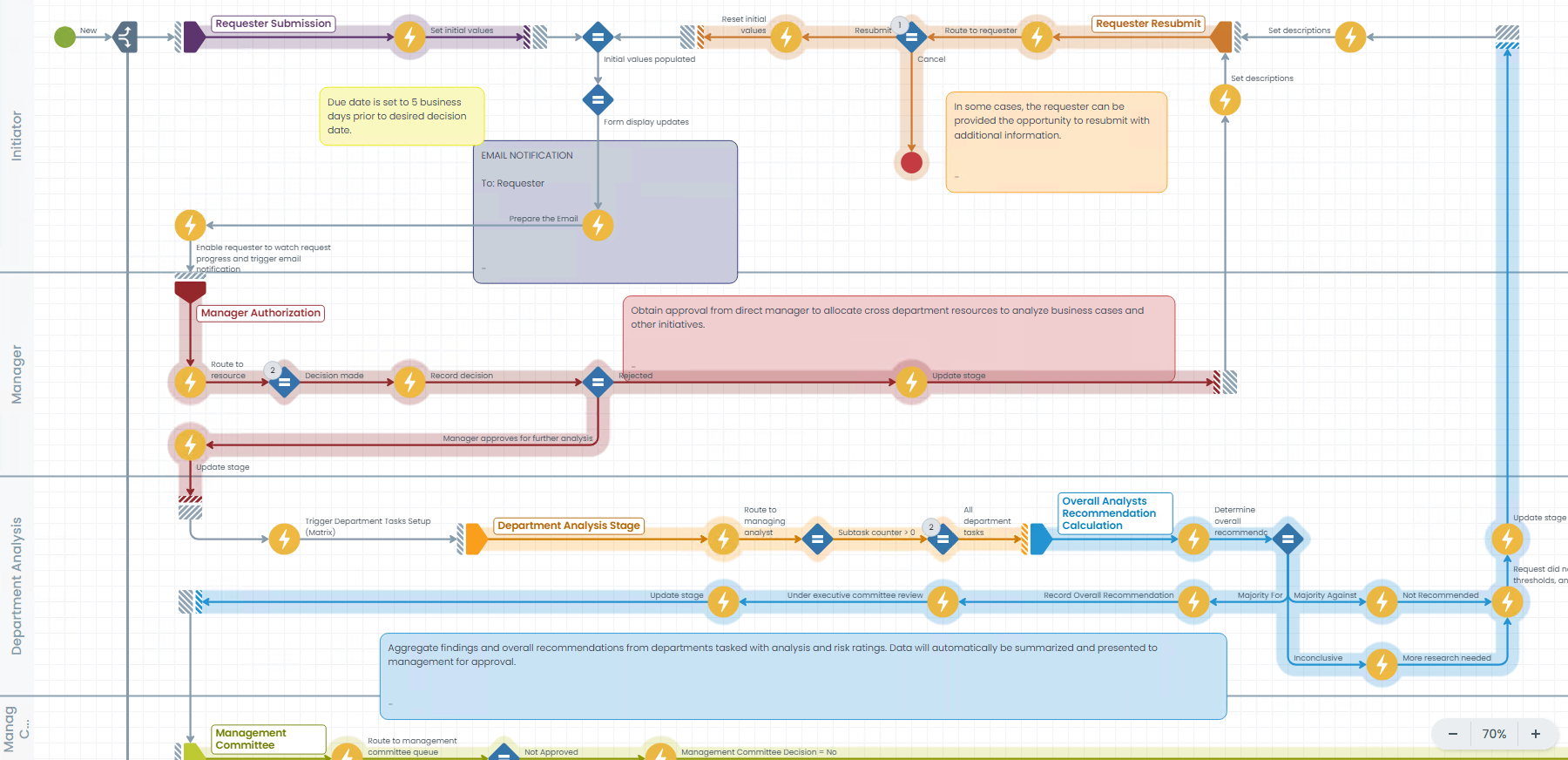
HighGear’s Visual Workflow Designer includes various features such as color-coded sections, ready-made process templates designed to accelerate automation, and real-time analytics that provide valuable data-driven insights.
Another notable feature of HighGear is its support for multi-user workflow design. Instead of isolating the creation process, it encourages collaboration, teamwork, and the inclusion of multiple perspectives in the improvement process. Conflicts are prevented and changes are quickly shared, ensuring alignment with the intended workflow and reducing the need for extensive training when embarking on workflow design.
ServiceNow
ServiceNow approaches workflow design similarly, offering users no-code visual workflow creation and automation. Users can design application-specific flow actions to design conditional trigger-based workflows.
Like HighGear, these workflows also include numerous features, including real-time data analytics, no-code triggers, role-based flows, and domain-separated workflows.
Unlike HighGear, however, ServiceNow’s workflows are not as easy to design and implement for non-IT personnel. Users often experience a steep learning curve and require assistance from already overburdened IT resources, especially when trying to adapt the platform to unique business needs. This often results in long deployments, reliance on developers, and incomplete solutions.
AI Capabilities and Governance
HighGear
HighGear helps business teams apply AI to the processes they manage. Its Workflow Assistant generates workflow drafts from process descriptions, while the AI Dashboard and Formula Assistants help users configure dashboards and administrators develop formulas. During execution, the Agentic AI Workflow Node can evaluate selected task data and return results for workflow routing or human review.
Administrators control the information AI can access and can place approval gates before sensitive actions. This supports use cases such as checking an onboarding request for missing information before routing it to an authorized reviewer. Our guide to AI agent governance in regulated workflows explains the available audit records, approval gates, and stop controls.
ServiceNow
ServiceNow takes an enterprise-wide approach to AI oversight. AI Control Tower, now marketed on its product site as Super Intelligence Control Tower, centralizes AI discovery, governance, security, monitoring, and value measurement. AI Workflow Factory connects process discovery, AI-assisted development, workflow execution, and ongoing improvement on the ServiceNow platform.
These capabilities are relevant for organizations coordinating AI across a broad technology estate. Teams considering HighGear should evaluate how its workflow-focused AI capabilities support the operational processes they need to build and maintain, alongside their wider governance requirements.
Scalability
HighGear
Although HighGear is primarily tailored for larger enterprises, it remains accessible and advantageous for smaller organizations aiming to utilize its workflow automation solutions and expand their operations.
HighGear’s Enterprise Task Management equips companies of diverse sizes to efficiently oversee complex workflows and comply with rigorous regulatory standards while maintaining agility, performance, and flexibility.
ServiceNow
Like HighGear, ServiceNow can be used both by smaller and larger organizations. As stated previously, though, smaller organizations may experience a difficult time during implementation given the need for technical expertise and/or specialized support resources.
Analytics & Reporting
HighGear
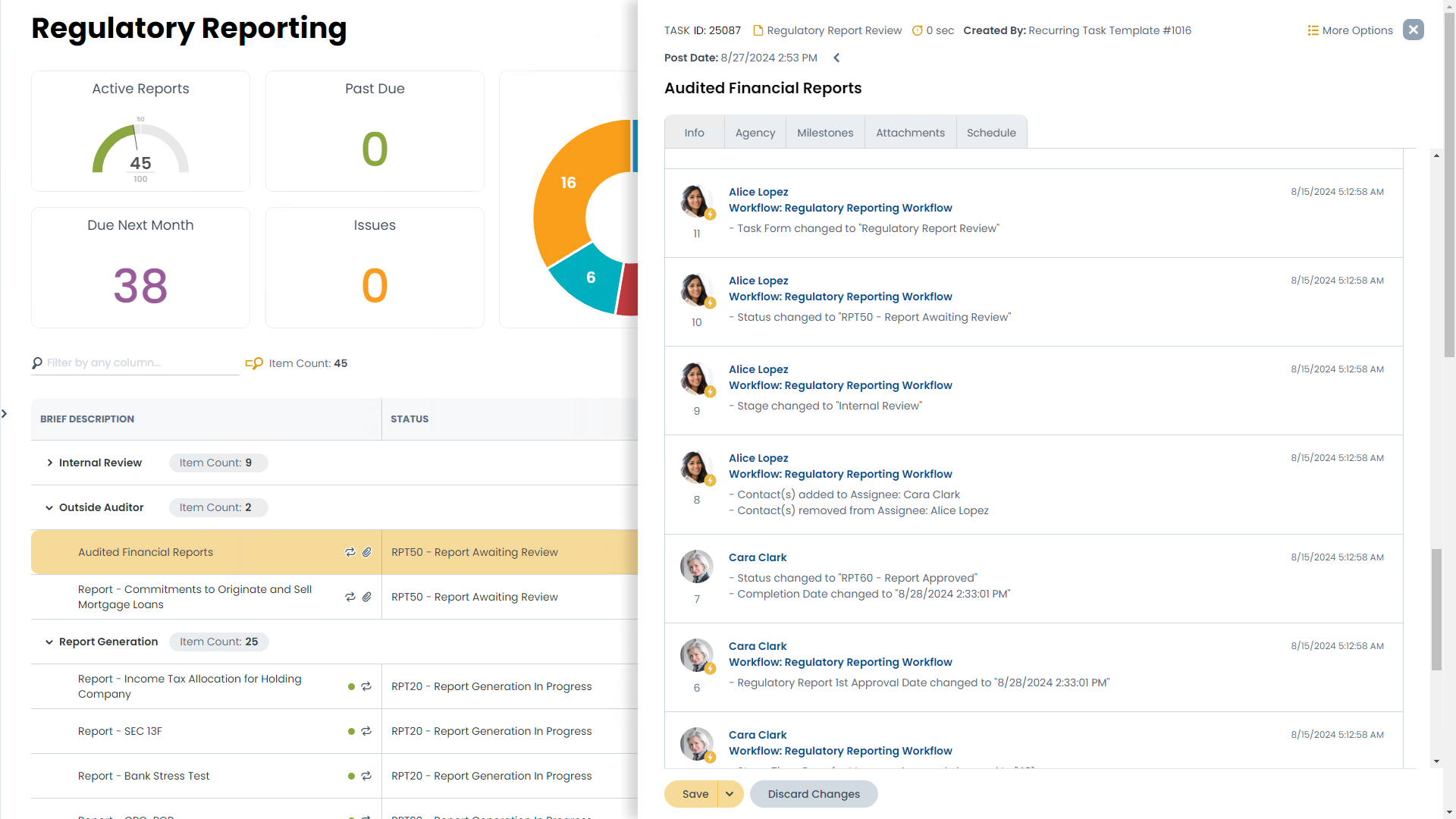
HighGear’s dashboards provide immediate, organization-wide insight into status and operations, resulting in a significant enhancement of business efficiency and responsiveness. The platform offers numerous real-time reporting and analytics tools, such as bar charts, trend lines, or tabular data. And by design, these tools can be used by anyone as HighGear has developed them with accessibility and ease of use as their top priorities.
Without any additional training or technical skills, users can create, schedule, and export comprehensive reports in multiple formats, streamlining the automated distribution process.
HighGear also functions as a dependable system for maintaining compliance records, offering extensive audit trails and activity logs by default. Its seamless integration with thousands of other business systems, such as ERP and CRM, facilitates data sharing to increase efficiency.
ServiceNow
Like HighGear, ServiceNow provides users with reporting and analytics tools, allowing access to past and real-time data. However, non-technical users will be limited to simple, high-level data for their dashboards and reports.
The platform does offer a more complex reporting and analytics module called Performance Analytics, but users may have to acquire specific technical knowledge or rely on developer support to provide shareholders and managers with in-depth data regarding past and real-time performance across the organization.
The problem here being, again, the sheer amount of information and the number of tools available adds to the already high complexity of the ServiceNow platform.
Integrations
HighGear
HighGear offers impressive integration capabilities. Natively integrated with open integration platforms like Zapier and Microsoft Power Platform, users can enjoy drag-and-drop connectivity with thousands of todays most popular enterprise applications.
Additionally, HighGear includes a comprehensive and secure API to integrate with everything else you need to connect across the enterprise, including PeopleSoft, SAML, PowerBI, Salesforce, Office 365, and many others.
ServiceNow
ServiceNow can be easily integrated with numerous systems and applications. The most prominent examples of possible integrations include Salesforce, Oracle, Microsoft Office, Workday, and DocuSign. Furthermore, all these integrations are easy to set up, making ServiceNow, like HighGear, a viable solution for workflow customization.
Deployment
HighGear
HighGear presents users with a choice between two deployment options: cloud-based and on-premise solutions.
Choosing the cloud-based solution delivers the advantage of accessibility from anywhere at any time, offering flexibility without the need to oversee infrastructure management.
On the other hand, HighGear allows companies to host the platform on their own servers on-premise, at the same cost point, providing them with greater control over the deployment environment.
ServiceNow
Like HighGear, ServiceNow offers on-premise deployment and utilizes cloud software to enable the integration of teams, processes, and data within a comprehensive cloud-based framework.
Customer Support & Education
When implementing enterprise-level software, comprehensive training and support are not merely optional but essential. Given the complexities of solutions at this scale, expert guidance and assistance are vital, particularly during the initial stages.
The absence of proper training can hinder an enterprise’s ability to fully exploit the platform’s capabilities, and inadequate support can lead to unresolved issues, impeding its effectiveness.
Luckily, HighGear and ServiceNow recognize the importance of this principle.
They both prioritize preparing organizations for success in automation, encompassing aspects from onboarding to continuous education and issue resolution. Now, let’s embark on a comparative analysis of how they perform concerning these two critical foundations: customer education and support.
HighGear
HighGear provides exceptional customer support and training services to its clients. Their team is comprised of experts who care deeply about helping customers and are empowered to invest as many resources as are needed to ensure customer success. The team is readily accessible through various communication channels, including email, phone, and screen-sharing sessions.
As an added support resource, HighGear also offers a dedicated Customer Success team. A Customer Success Manager is specifically assigned to each client (at no additional cost for the Department license tier and above) who serves as a client’s business process and workflow management coach, mentor/advisor, and client advocate. They are accountable for proactively engaging with each client’s key stakeholders on at least a quarterly basis, and ensuring clients have access to all of HighGear’s vast experience, knowledge, best practices, and personnel to finely tune the platform to solve even the most unique business need. When it comes to training, HighGear offers an integrated set of self-service help resources, which include step-by-step instructions, videos, and comprehensive documentation for troubleshooting.
For those who prefer hands-on learning, HighGear offers complimentary instructor-led training sessions designed to enhance proficiency in process design and effective feature utilization.
Furthermore, HighGear’s support system contains a vast repository of detailed help articles, tutorials, and videos. This extensive resource empowers customers to independently search for answers to their queries.
In addition, the close collaboration between the support team and product development ensures an in-depth understanding of the platform, providing expertise that spans every aspect of it.
ServiceNow
ServiceNow doesn’t yield to HighGear in this regard. The customer support team is responsive and easily accessible 24/7 via phone, email, and live chat. The site also has a dedicated FAQ section where users can quickly find answers to the most common questions.
Their training services are also impressive, with ServiceNow offering multiple educational resources, including training video courses, white papers, tutorials, and help articles. You can also become a certified ServiceNow user through their certification training program.
Reviews and Case Studies
This review covers just one aspect of the narrative. To gain a comprehensive understanding of whether HighGear is a superior alternative to ServiceNow, it’s essential to delve deeper into the feedback and opinions shared by actual users of both platforms.
Client Testimonials
As we’re writing these words, HighGear boasts a stellar 5.0 out of 5 rating on GetApp & Capterra. But what exactly do HighGear users have to say about the platform?
“Fantastic – the team has been great, always available to answer any questions. It’s changed our business completely.” – Alexandra S.
“Good way to track workflows and good for auditing purposes.” – Kathleen T.
“The reason why we started using HighGear is because it’s flexible, customizable and suitable for large volumes of projects.” – Vincent W.
These reviews speak volumes about HighGear, proving it to be an excellent choice when seeking a no-code workflow management solution.
Now, let’s see how ServiceNow compares when it comes to customer reviews.
Their GetApp and Capterra scores are slightly lower than that of HighGear’s, with an average rating of 4.5 out of 5. However, while there is praise regarding ServiceNow’s advanced automation features, many customers complain about the steep learning curve and lack of realistic opportunities for citizen developers to utilize the platform.
Case Studies
HighGear offers an impressive array of case studies that provide in-depth insights from notable figures in the realms of global finance, energy, government, and numerous others. These case studies vividly demonstrate the remarkable versatility of HighGear’s platform.
ServiceNow’s collection of case studies also pulls from a wide range of brands and industries.
Pricing
Both platforms are full of excellent and high-end features and tools. However, the question is, are these apps worth their pricing? Which one offers the best value for your investment – HighGear or ServiceNow?
HighGear
HighGear offers contributor-based pricing, with plans starting at $26 per licensed contributor per month. AI features are included for all tiers at no extra cost. A minimum of 25 contributor licenses and an annual subscription are required. Volume and term discounts are available.
Plans offer different levels of workflow capacity, support, and enterprise functionality. Visit HighGear’s pricing page to compare plans and available features.
ServiceNow
ServiceNow provides custom quotes for its product packages. Pricing depends on the selected products and requirements, and AI capabilities vary by package.
Organizations must contact ServiceNow for pricing applicable to their deployment. For example, its IT Service Management pricing page outlines available packages and their included capabilities, with pricing provided through a custom quote.
Final Thoughts: Is HighGear the Best ServiceNow Alternative?
If your priority is giving business teams control over operational workflows, a HighGear demonstration can show how AI-assisted configuration, task evaluation, and human approvals fit together in a process relevant to your organization.
Or